
The holiday season is here! It's time for family gatherings, a prime opportunity to learn more about your family history!
In today’s fast-paced world, capturing and preserving our family history can feel daunting. But by using a few thoughtful tools and approaches, you can create lasting memories that future generations will cherish. From interview questions that spark meaningful stories to photos that bring the past to life, here are some simple yet powerful ways to document your family’s unique journey.
Interview Questions: Sparking the Stories that Matter
Asking the right questions can open up a world of memories. When interviewing family members, there are several goals you might be trying to achieve. Each can be discovered by the type of questions you ask. Here are some to get you started:
Generic questions
These are questions that help you understand what defined your relative, how they lead their life and what in their history may have helped guide them. These are open ended questions meant to spark stories.
- What’s a childhood memory that has stayed with you?
- What was a defining moment in your life, and how did it change you?
- Is there a family tradition or saying that brings back memories?
- What advice would you give to younger generations?
Specific questions
Direct questions that pertain to a time frame in their life. They help you add context to their journey.
- Who taught you to dance?
- What’s your favorite job and why?
- Who was your best friend growing up?
- How did dad ask you to marry him?
Research related questions
Are there portions of your family members life that you would like to do some research on? These questions are meant to help provide you with names and places to reach out to for potential photos, documents and stories.
- What sports did you play and what were your teams?
- Where was your father stationed during the war?
- What clubs or organizations have you belonged to?
- Where were some places you lived?
Be patient and let them reminisce. Sometimes the best stories come from unexpected memories. Encourage them to elaborate and share details that reveal their personality and values. You’ll also learn more about their parents, siblings, friends, and co-workers. You might even learn something surprising!
Preparing Your Questions: Analog or Digital?
There are many reasons to prepare yourself either way. The most important variable is your comfort level. Let’s explore the benefits of both and why I find using a mixture can help lead to a more successful interview.
Analog: The Tactile Version
Tangible items are easier to hold, pass around the room, and generally share with those around you. People also find something to physically hold brings a closer connection.
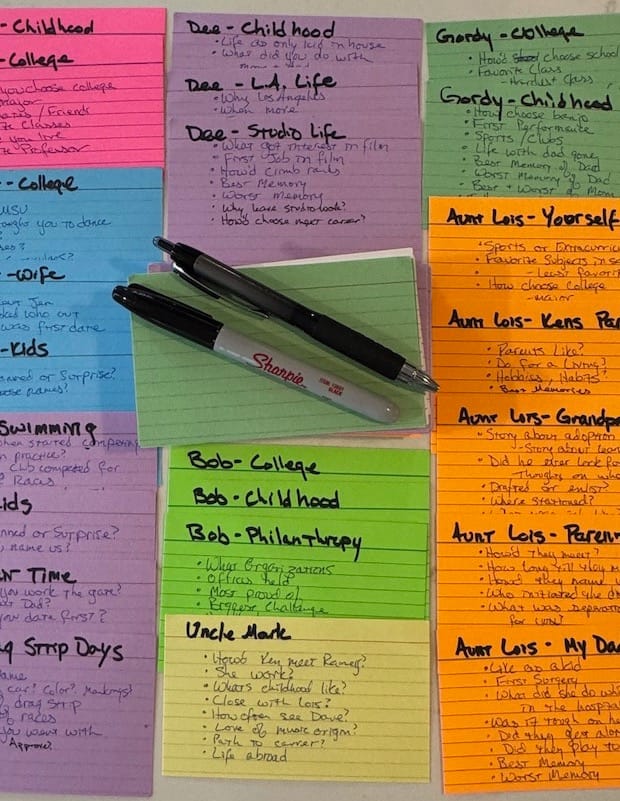
Use index cards for each person
Pros
- You can carry the cards with you for easy access as you think of topics
Cons
- Handwriting can be hard to read, especially if you scratch out and rewrite your questions.
- Harder to organize in a coherent order as you may think of them sporadically
Tips
- Assign a color to each family member
- Use the cards for topics
- Don’t write out the full question; use the cliff note version
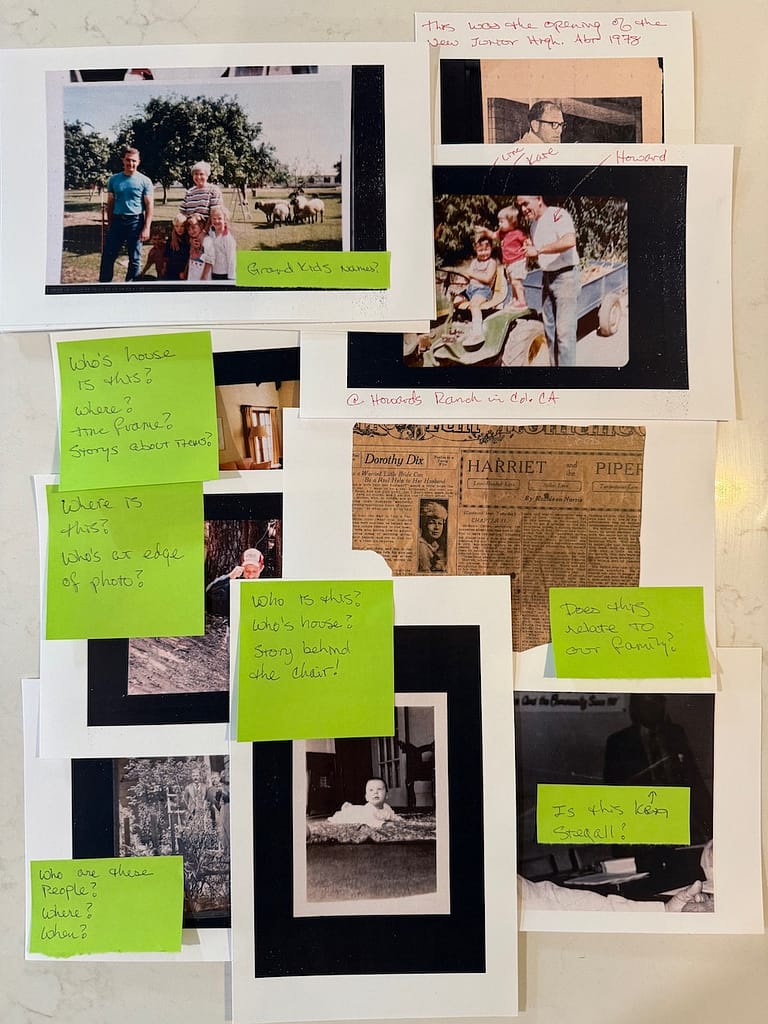
Post-it notes on each photo
Pros
- Allows you to sort through the photos, following direction changes that come from natural conversations
- Holding a physical photo can be more nostalgic
Cons
- Easier to get your topics out of order, causing you to revisit topics already discussed
Tips
- Use reprints, not original photos, all printed at the same size
- Write answers, draw on the prints, anything you need to capture the information you seek.
- Write your questions on Post-it notes so you can hold them while the person you’re interviewing holds the photo.
Digital: Reorganize and Share
Technology is always with most of us, making it easy to add thoughts and questions to our lists anytime. Some people find technology impersonal, so think about the tastes of the people you will interview.

Reminder Lists
Pros
- Drag to reorder questions to keep topics together
- Attach photos, documents, and notes to each question
- Check each question as it’s answered, streamlining your view of what remains
Cons
- The need to have the photos on a second device or app
Tips
- Create a list for each person
- Use topic headers
- Indent the questions
- Share individual lists with others so they can add their questions too.

Digital Albums
Pros
- Share to a TV so everyone can follow the interview
- Portable!
Cons
- Requires a device to share
Tips
- Make sure the TVs at your location can accept connections.
- Create albums by person and topic; they’ll be easier to search through without distraction
- Make sure you bring all cables and chargers!
My Process: A Mix of Both!
I am an Apple Reminders user. I love how the same list is on all of my devices, so no matter what I’m working on or where I am, I can always add to it. For everything family history related, I have a folder titled “Family Questions”, within that are lists for each person. I can copy questions in between lists, drag to rearrange them as needed, and collapse topics to keep things streamlined.
I have found answers to the majority of the photos I have. The questions I have for my family are more research related . I’m looking for more people and places to research to fill in gaps in my family’s stories. When I have an image, I attach a digital version to the question as a reminder to hand the physical print to the person I’m interviewing as I ask the question or discuss the topic.
Additional Tips
Take a Hard Drive!
If your family members have media they’re willing to share with you, taking an external hard drive with you is a great idea! External drives are the easiest way to gather information from multiple sources, and often a much faster process than downloading items from shared links.
If you’re a “family divided” between iOS and Android devices, make sure you have an exFAT formatted drive. They work seamlessly between both operating systems. External drives and thumb drives can be found by searching for “exFAT formatted drives” on Amazon or at your local electronics retailer. I suggest purchasing the largest capacity drive that your budget will allow. The most disappointing thing is to run out of storage when you have access to the mother load of information!
I love this process for technologically challenged relatives who are unsure about how to share files. It’s also great for password-protected sites people may store information on.

I like to use the following folder structure to keep files from different people organized. Breaking it up by person, device, and topic is helpful as you go through them and if you have any questions.
- Mom
- iPhoto
- DropBox
- Ancestry
- GEDCOM
- Documents
- Brother
- Laptop
- Family Business Files
- Kids school files
- Photo CD’s
- Memory Cards
- Laptop
Check out our previous blog that is full of successful interview tips!
Our 9/11 blog is full of tips!
- Setting up your interview area
- Equipment that helps the process
- Sample questions to help get the most out of your time together.

Organize your media in groupings inside of each catalog.
Read on to learn how Archoral Collections can help you organize, capture, and share the story of your family!


